
 Post by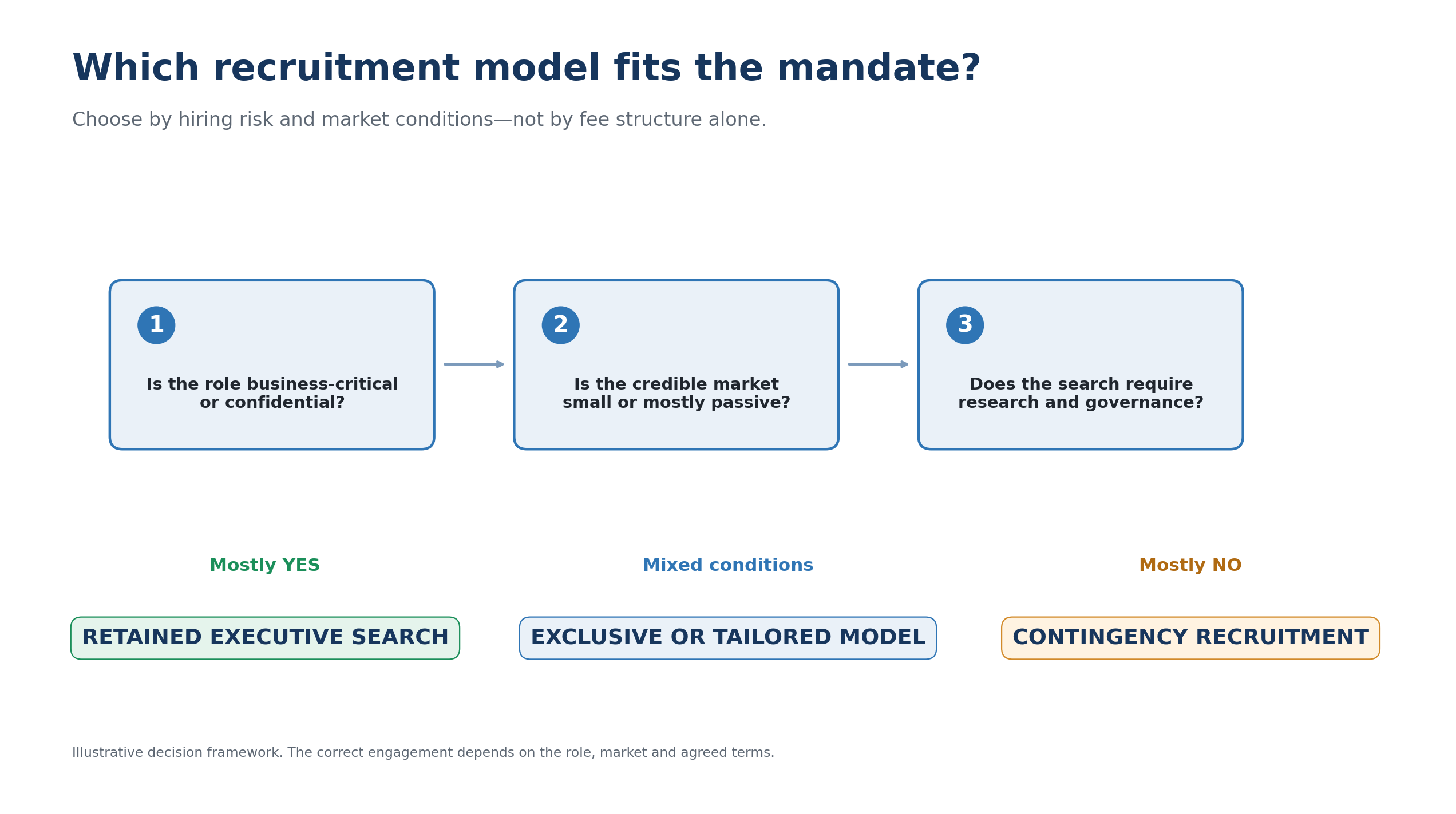
How to choose the right recruitment model for the role, market and level of hiring risk
Retained executive search and contingency recruitment can both produce successful hires, but they are designed for different conditions. The right choice depends less on which model appears cheaper and more on the importance of the role, the size and visibility of the candidate market, the need for confidentiality, and the level of research and assessment required.
For a confidential Country Manager replacement or a scarce C-suite mandate, a committed search may provide the control and market coverage the employer needs. For a professional role with a broader active-candidate pool and a clear specification, contingency recruitment may be efficient and commercially appropriate. Neither model is automatically superior.
This guide compares the two approaches in a Thailand hiring context and provides a practical framework for choosing between them. Employers reviewing broader hiring support can also explore 43 Synchronize’s recruitment services in Thailand.
Quick Answer
Choose retained executive search when the appointment is business-critical, confidential, senior, difficult to map or dependent on engaging passive talent. Consider contingency recruitment when the role has a sufficiently broad candidate market, the brief is stable, confidentiality is limited and payment on successful placement matches the required process. For mixed conditions, an exclusive or tailored arrangement may be appropriate if responsibilities, deliverables and terms are clearly documented.
Contents
- What retained executive search means
- What contingency recruitment means
- Side-by-side comparison
- A six-factor decision framework
- Cost, value and hiring risk
- Thailand hiring scenarios
- Questions to ask a recruitment partner
- Common mistakes
- Frequently asked questions
What Is Retained Executive Search?
Retained executive search is a committed engagement in which an employer appoints a search firm to lead a defined mandate. The assignment commonly includes role calibration, target-company research, market mapping, confidential direct approaches, structured assessment, shortlist reporting and process management. Commercial terms vary by firm and agreement; the defining feature is the committed search process, not one universal payment schedule.
The model is most useful when the employer needs to understand and reach the relevant market rather than wait for applicants. That distinction matters for C-suite, Country Manager, functional-head and other high-impact roles because many qualified candidates are already employed and may only consider a credible, discreet approach.
Typical retained-search conditions
- The appointment materially affects strategy, revenue, governance, operations or succession.
- The search must remain confidential because an incumbent, transaction or market-entry plan is involved.
- The credible candidate pool is small, fragmented or difficult to identify.
- Passive executives must be approached individually and the opportunity represented consistently.
- Several stakeholders require calibrated assessment, reporting and decision governance.
- The employer values full-market evidence, including why prospects declined or were ruled out.
For leadership mandates of this kind, review 43 Synchronize’s executive search in Thailand capability.
What Is Contingency Recruitment?
Contingency recruitment generally means the recruitment fee becomes payable when an agreed hiring outcome occurs, subject to the contract. The model is frequently used for professional and management hiring where the candidate market is broad enough for a recruiter to produce qualified options without the same level of dedicated market research required in a retained assignment.
Contingency does not have to mean unstructured or low quality. A capable recruiter can still clarify the brief, source directly, assess candidates and manage interviews. However, employers should understand how the agency prioritizes assignments, whether the mandate is exclusive, what research will be completed and what happens if multiple suppliers approach the same candidates.
Typical contingency conditions
- The role has a reasonably visible and active candidate pool.
- The specification is stable and can be assessed through a standard recruitment process.
- The vacancy is important but does not require board-level governance or discreet succession planning.
- The employer has internal capacity to coordinate screening, interviews and candidate communication.
- A success-based commercial structure fits the scope and expected market effort.
Retained vs Contingency Recruitment: Side-by-Side
| Decision area | Retained executive search | Contingency recruitment |
| Commercial commitment | Committed assignment; payment terms vary and may be staged. | Fee is commonly linked to a successful placement; exact trigger varies. |
| Exclusivity | Usually exclusive for the agreed mandate. | May be exclusive or non-exclusive, depending on the agreement. |
| Research depth | Designed for target mapping and systematic market coverage. | Often focused on accessible candidates, networks and responsive sourcing. |
| Candidate market | Well suited to passive, scarce or sensitive senior talent. | Well suited to broader professional or management talent pools. |
| Confidentiality | Strong fit for discreet replacement, succession or market entry. | Possible, but multi-agency activity can make control harder. |
| Assessment | Typically calibrated to a leadership scorecard and mandate. | Typically aligned to the job brief and candidate suitability. |
| Reporting | Regular market feedback, pipeline visibility and steering meetings. | Reporting depth varies by supplier and agreement. |
| Best use | Critical, senior, confidential, complex or hard-to-map roles. | Clear roles with sufficient candidate availability and lower search complexity. |
These are common characteristics, not legal definitions or universal service standards. Employers should rely on the written engagement terms and scope offered by the selected firm.
Use Six Factors to Choose the Model
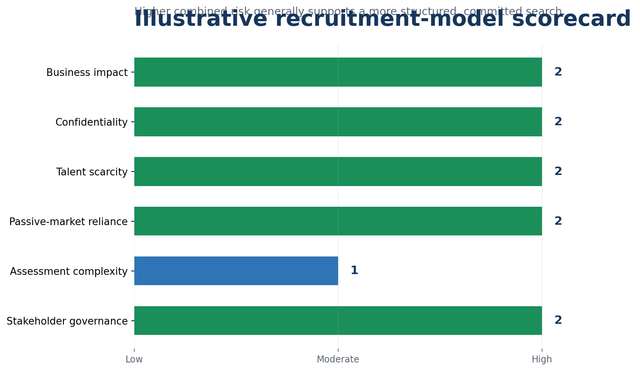
Score each factor from 0 to 2: low, moderate or high. A high combined score does not mechanically require retained search, but it signals that a success-only, loosely governed process may not provide sufficient control. The hiring team should document its reasoning before requesting proposals.
| Factor | Decision question |
| Business impact | What happens to revenue, operations, governance or strategy if the seat remains vacant or the hire fails? |
| Confidentiality | Would public or duplicated outreach expose a succession, replacement, restructuring or expansion plan? |
| Talent scarcity | How many candidates have delivered comparable outcomes in a similar business context? |
| Passive-market reliance | Are the best prospects unlikely to apply and likely to require a tailored approach? |
| Assessment complexity | Does the employer need evidence across P&L, leadership, transformation, culture and stakeholder management? |
| Stakeholder governance | Will a board, regional headquarters, investors or multiple functional leaders shape the decision? |
Do Not Compare Fee Alone: Compare Total Hiring Risk
The recruitment fee is visible; the cost of an unsuitable or delayed appointment is often distributed across the business. A sensible comparison includes vacancy impact, management time, candidate reach, duplicated work, interview quality, offer risk and the potential cost of restarting the search.
A lower-commitment model can be economical when the market is broad and the internal team can manage the process. It can become expensive if several agencies duplicate outreach, strong candidates receive inconsistent messages, or the role repeatedly loses priority. A retained process can justify deeper research for a critical role, but only if the provider defines the search team, target universe, reporting cadence, assessment method and expected deliverables.
A practical total-cost checklist
- Vacancy cost: delayed decisions, lost revenue, operational pressure or leadership gaps.
- Internal time: briefing multiple agencies, reviewing repeated profiles and coordinating candidate ownership.
- Market access: active applicants only versus systematic engagement of passive prospects.
- Decision quality: comparable evidence, reference depth and stakeholder calibration.
- Candidate experience: consistent communication, confidentiality and offer management.
- Restart risk: what happens if the shortlist, offer or appointment does not succeed?
Five Thailand Hiring Scenarios
| Hiring situation | Likely fit | Reason |
| Confidential CFO replacement | Retained search | The mandate is sensitive, the candidate pool is senior and market leakage could affect the incumbent or stakeholders. |
| Country Manager for market entry | Retained or tailored exclusive search | The search requires mandate design, cross-sector mapping, passive outreach and regional stakeholder alignment. |
| Multiple mid-level finance positions | Contingency or structured multi-hire solution | The market is broader and a repeatable assessment process may matter more than full executive mapping. |
| Scarce plant or operations leader | Retained or exclusive specialist search | Relevant leaders may sit in a narrow industrial cluster and require direct, technically credible engagement. |
| Professional vacancy with active supply | Contingency recruitment | A clear brief and sufficient candidate availability can support a success-based process. |
The recommendation can change after market calibration. A role that appears broad may become a retained-style search once language, location, sector, transformation experience and compensation constraints are combined.
Organizations requiring focused functional or sector support can review specialized recruitment in Bangkok. For an example of a role-led executive mandate, see the Country Manager hiring guide.
Questions to Ask Before Appointing a Recruitment Partner
| Area | Question for the provider |
| Search ownership | Who will lead the assignment, conduct research, approach candidates and attend progress meetings? |
| Market method | Will the team map named target companies and passive prospects, or rely mainly on existing databases and applicants? |
| Scope and exclusivity | Is the mandate exclusive? Which locations, sectors, roles and candidate sources are included? |
| Deliverables | What will the employer receive: role calibration, market map, longlist, shortlist reports, references or assessment support? |
| Reporting | How often will the pipeline, market response, compensation feedback and risks be reviewed? |
| Confidentiality | When is the client identity disclosed, and how are candidate and incumbent information protected? |
| Candidate ownership | How are duplicates, prior introductions and ownership periods handled? |
| Commercial terms | What triggers payment, what expenses apply and what happens if the mandate changes or stops? |
| Aftercare | What onboarding, follow-up or replacement terms apply, and what exclusions are written into the agreement? |
| Data handling | How are candidate consent, retention and personal data managed under applicable requirements? |
Common Mistakes to Avoid
Using multiple agencies as a substitute for market coverage
More suppliers can create more activity, but not necessarily a broader or better-mapped market. Duplicate approaches and inconsistent messages can weaken the employer proposition, especially within a small senior network.
Selecting retained search without defined deliverables
Commitment should buy a transparent method. Confirm the search owner, target-market logic, progress cadence, assessment standard and escalation process in writing.
Treating every senior title as an executive-search mandate
The title alone is not decisive. A visible candidate market and a stable brief may support contingency recruitment even at management level. Conversely, a specialist role without a senior title may still require retained-style research because the talent pool is exceptionally scarce.
Waiting until offer stage to align compensation and authority
An attractive title cannot compensate for unclear decision rights, an unrealistic package or conflicting stakeholder expectations. Calibrate these issues early using evidence from the market.
Confusing speed with urgency management
Urgency requires focus, rapid decisions and accountable communication. It does not justify skipping role calibration or assessment. A fast but unstable appointment creates a larger delay later.
Senior hiring also depends on reaching candidates beyond job advertisements. Read why job boards fail C-suite hiring for the related sourcing perspective.
Frequently Asked Questions
Is retained executive search always better than contingency recruitment?
No. Retained search is usually better suited to critical, confidential, scarce or research-intensive mandates. Contingency recruitment can be effective where the market is broad, the brief is clear and a success-based model matches the required work.
Is retained search only for C-suite roles?
No. Seniority is only one factor. A technically scarce specialist, confidential replacement or hard-to-map regional role may justify retained research even without a C-suite title.
Does contingency recruitment mean several agencies must work on the role?
No. A contingency agreement may be exclusive or non-exclusive. Employers should decide deliberately and document candidate ownership, communication and reporting expectations.
When are retained-search fees paid?
Payment structures vary by provider and agreement. They may be linked to engagement or defined milestones. Review the written terms rather than assuming one standard model.
Can an employer change models after a search begins?
Potentially, but the parties should first identify why the original process is not working. Any change to scope, exclusivity, fees, candidate ownership or deliverables should be agreed in writing.
What information should an employer provide before a proposal?
Share the mandate, reporting line, business outcome, location, compensation range, confidentiality level, essential experience, interview stakeholders and desired timing. Better calibration produces a more credible search recommendation.
Conclusion: Match the Search Model to the Hiring Risk
Retained executive search and contingency recruitment solve different hiring problems. The employer’s task is to identify the problem accurately. When a role is confidential, business-critical, dependent on passive candidates or difficult to assess, a committed search process can provide stronger market coverage and governance. When the role is clear and the candidate market is sufficiently accessible, contingency recruitment can be a practical and efficient choice.
Whichever model is selected, insist on a written scope, accountable ownership, consistent candidate communication and evidence-based assessment. The best commercial model is the one that gives the organization enough process to manage the real risk of the appointment.
Need help choosing an appropriate search approach for a leadership or specialist vacancy in Thailand? Contact 43 Synchronize to discuss the mandate, candidate market and level of confidentiality before the search begins.
