
 Post by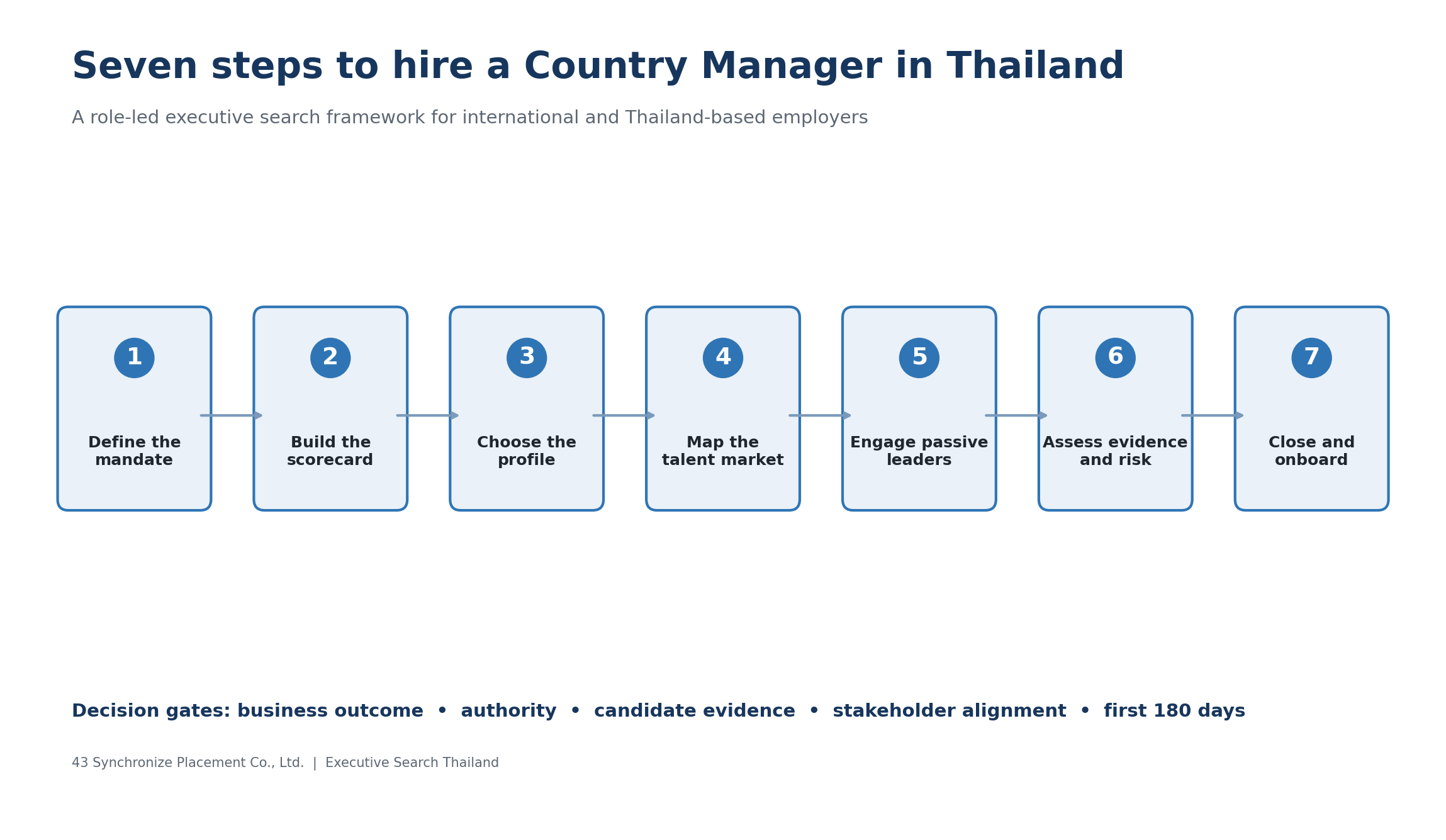
A practical seven-step guide for employers
A Country Manager can determine whether a Thailand operation converts regional strategy into local results. The role often carries responsibility for revenue, people, market entry, compliance coordination, key accounts and communication with regional headquarters. Yet many searches begin with a familiar title and an old job description rather than a clear business mandate.
That is where hiring risk begins. A leader suited to launch a new market may be wrong for a turnaround. A strong commercial executive may lack the operating discipline to build a local team. A candidate with an impressive multinational background may still struggle if decision rights between Thailand and regional headquarters are unclear.
This guide explains how to hire a Country Manager in Thailand through a structured process that starts with the required business outcome and ends with a practical first-180-day plan. Employers considering a confidential or business-critical appointment can also review 43 Synchronize’s executive search in Thailand service.
Contents
- Define the Country Manager mandate
- Build an assessment scorecard
- Choose the right candidate profile
- Map the relevant talent market
- Engage passive leaders
- Assess evidence and appointment risk
- Align the offer authority and onboarding
- Common hiring mistakes
- Frequently asked questions
1 Define the Country Manager Mandate
Start with the business problem, not the job title. Two organizations may both advertise for a Country Manager while expecting completely different outcomes. One may need a market-entry leader who can establish customers, local partnerships and an initial team. Another may need an operator who can repair margins, rebuild trust or integrate a recently acquired business.
The hiring team should agree on five points before sourcing begins: the result expected in the first year, the authority attached to the role, the resources available, the stakeholders who will judge success and the conditions that could prevent the new leader from delivering.
| Mandate | Business outcome | Capabilities to test |
| Market entry | Establish the Thailand operation, win initial customers and build local capability. | Entrepreneurial judgement, commercial development and comfort with ambiguity. |
| Growth | Scale revenue, channels, teams or geographic coverage. | P&L ownership, sales leadership, talent development and execution discipline. |
| Turnaround | Improve performance, rebuild a team or correct operational weaknesses. | Diagnostic ability, difficult decision-making, change leadership and credibility. |
| Integration | Connect a Thailand business with regional systems, governance and reporting. | Stakeholder management, process integration and communication across cultures. |
| Succession | Replace or develop beyond an established leader without destabilizing the business. | Discretion, continuity planning, internal credibility and long-term leadership fit. |
A precise mandate improves every later decision. It defines the candidate universe, interview questions, compensation logic and the evidence required for a credible shortlist.
2 Build an Assessment Scorecard Before Interviews
A job description lists responsibilities. A scorecard defines evidence. It converts broad expectations into a small set of outcomes and capabilities that every interviewer can assess consistently.

The weightings above are illustrative. A market-entry search may give more weight to customer acquisition and ambiguity. A manufacturing operation may place greater weight on operational leadership, safety, supply chain and plant performance. The important point is to set the weighting before meeting candidates, so interview charisma does not change the criteria halfway through the process.
| Scorecard area | Evidence question |
| Commercial outcomes | What size of P&L, growth target, margin improvement or market launch has the candidate personally led? |
| Thailand market knowledge | Which customer, channel, regulatory and competitive conditions has the candidate navigated directly? |
| People leadership | What team did the candidate inherit, build or change, and what evidence shows the result? |
| HQ and local alignment | How has the candidate handled conflicting expectations between regional leadership and local execution? |
| First 180 days | Can the candidate diagnose priorities, sequence action and state what should not be changed too quickly? |
3 Choose the Right Candidate Profile
The choice should not be reduced to Thai versus expatriate. The better question is which experiences and relationships are essential for the mandate. A local leader may bring deep customer access, cultural fluency and knowledge of the domestic talent market. An expatriate or regional executive may bring transformation experience, global operating standards or specialist knowledge that is scarce locally. Some searches should consider both.
| Profile route | When it may fit |
| Local market depth | The mandate depends on domestic customer relationships, government or industry networks, local channels or rapid team credibility. |
| Regional or global transfer | The mandate depends on transferring a proven operating model, integrating Thailand with a regional business or leading a specialist transformation. |
| Hybrid shortlist | The business can define outcomes clearly and compare candidates on evidence rather than nationality or familiarity. |
If the preferred candidate will require immigration or work authorization support, involve qualified legal and mobility advisers early. Do not wait until offer stage to discover that timing, documentation or company eligibility could affect the appointment.
4 Map the Talent Market Before Approaching Candidates
A Country Manager search should begin with a talent map, not a database search. The map identifies where relevant leadership capability is likely to exist and which adjacent sectors may contain transferable experience.
The target universe can include direct competitors, companies with similar customer channels, regional headquarters, businesses that have completed a comparable launch or turnaround, and senior successors who already operate one level below a Country Manager. This approach avoids an unnecessarily narrow search while keeping every target connected to the mandate.
For a manufacturing appointment, for example, the map may connect Country Managers with Managing Directors, Operations Directors and commercial leaders from businesses with comparable plant, distribution and regional-reporting complexity. Employers can explore 43 Synchronize’s manufacturing and supply chain recruitment coverage for the related leadership market.
Market mapping should answer four practical questions:
- Which companies contain leaders who have solved a comparable problem?
- How many credible candidates are likely to exist in Thailand or the wider region?
- Which requirements are essential, and which can be learned after appointment?
- What compensation, authority or career proposition will be needed to attract them?
5 Engage Passive Leaders Confidentially
Many credible Country Manager candidates are already employed and are not applying to advertisements. They may have a strong internal reputation, retention incentives, unfinished transformation work or legitimate concerns about confidentiality. A public vacancy can reveal the opportunity, but it rarely reaches the full talent market.
Direct outreach works when it is specific. The first conversation should explain why the candidate is relevant, what the business needs to accomplish and how the role differs from a generic vacancy. Generic messages reduce trust. Read more about why job boards fail C-suite hiring and how direct sourcing reaches candidates beyond the active applicant market.
Confidentiality matters on both sides. Employers may be replacing an incumbent, preparing a market entry or managing a restructuring. Candidates may need assurance that their interest will not reach their current employer. The search process should define who can access candidate information, when the client identity is disclosed and how interview communication will be handled.
6 Assess Evidence and Appointment Risk
Country Manager interviews often fail when senior stakeholders hold broad conversations and assume experience will transfer automatically. Structured interviews are more reliable because each interviewer tests a defined part of the scorecard and asks for evidence from comparable situations.
Useful questions include:
| Assessment area | Evidence-based interview question |
| Market entry | Tell us about a market or business unit you built. What did you inherit, what decisions did you make, and what measurable result followed? |
| P&L leadership | Which levers changed revenue, gross margin or operating cost under your direct control? |
| People decisions | Describe a leadership team you inherited. Who did you retain, develop or replace, and why? |
| Regional alignment | Give an example of a disagreement with regional headquarters. How did you protect local execution while maintaining trust? |
| Cultural judgement | Describe a decision that was technically correct but required a different communication approach in Thailand. |
| Failure and learning | Which leadership decision did not work as expected, and what did you change afterward? |
References should verify the same scorecard rather than ask whether the candidate was generally “good.” Ask former stakeholders about decision quality, team impact, integrity, delivery under pressure and the conditions in which the executive performed best. Where appropriate, use a case discussion based on a realistic business problem, but avoid requesting confidential information from the candidate’s current employer.
7 Align the Offer Authority and Onboarding
A strong candidate can still decline if the role lacks clarity or the hiring process reveals disagreement among stakeholders. Country Manager candidates will usually assess the full proposition: decision authority, board or regional access, team quality, investment commitment, performance measures, compensation and the personal risk of moving.
Discuss compensation expectations early enough to avoid a late-stage mismatch. The offer should state how performance will be measured, which decisions the Country Manager controls and which require regional approval. A senior title without practical authority creates avoidable hiring and retention risk.
The onboarding plan should begin before the start date. A useful first-180-day framework includes:
- Days 1 to 30: meet the leadership team, customers and key regional stakeholders; test the assumptions behind the mandate.
- Days 31 to 60: confirm priorities, capability gaps, decision rights and immediate risks.
- Days 61 to 100: begin agreed commercial, operational or organizational actions.
- Days 101 to 180: report progress against the scorecard and adjust the plan with the board or regional leadership.
Common Country Manager Hiring Mistakes
| Hiring mistake | Why it creates risk |
| Reusing an old job description | The previous document may describe tasks, not the current business problem. |
| Starting with a preferred person | The criteria can become biased toward one familiar profile before the market is understood. |
| Overvaluing brand names | A respected employer on a resume does not prove comparable authority or outcomes. |
| Leaving authority undefined | Candidates cannot judge the role, and the appointed leader may be unable to deliver. |
| Running an unstructured interview process | Different stakeholders test different criteria and make inconsistent comparisons. |
| Discussing compensation too late | A preventable mismatch can end the process after significant time has been invested. |
| Treating onboarding as administration | The first months determine stakeholder trust, priorities and early execution. |
When to Use an Executive Search Partner
An employer should consider a specialist search when the appointment is confidential, the required candidates are unlikely to apply, the business lacks a Thailand leadership network, the mandate is difficult to define, or a failed hire would materially affect market entry or performance.
43 Synchronize combines role calibration, talent-market mapping, direct cold hunting, structured assessment and offer support for business-critical appointments. Review the full range of recruitment services in Thailand or speak with the team about a confidential Country Manager search.
Frequently Asked Questions
How long does it take to hire a Country Manager in Thailand?
The timeline depends on role complexity, confidentiality, notice periods, interview availability and whether the search includes regional or expatriate candidates. A clear mandate and timely stakeholder decisions reduce avoidable delays.
Should a Country Manager in Thailand be Thai or expatriate?
There is no universal answer. Define the business mandate first, then compare candidates on market access, operating experience, leadership evidence, stakeholder fit and the practical requirements of the appointment.
Can job boards find Country Manager candidates?
They may identify active candidates, but they do not provide complete access to employed leaders who are not applying. A critical search should combine visible applicants with targeted market mapping and direct outreach.
What should a Country Manager scorecard include?
It should cover the required commercial outcome, Thailand market knowledge, people leadership, regional and local stakeholder management, decision authority and the expected first-180-day plan.
What is the difference between Country Manager recruitment and executive search?
Recruitment may begin with an advertised vacancy and active applicants. Executive search starts with the mandate, maps the relevant talent market and directly approaches qualified leaders, including passive candidates.
How can an employer reduce Country Manager hiring risk?
Agree on outcomes and authority before sourcing, use structured evidence-based interviews, verify references against the scorecard, align compensation early and prepare a practical onboarding plan.
Conclusion
A successful Country Manager search begins with clarity. The employer must define the business result, decision authority and evidence of success before approaching the market. From there, talent mapping, confidential outreach and structured assessment create a defensible way to compare leaders who may come from different sectors or career paths.
The final decision should connect the candidate’s proven experience with the actual Thailand mandate. When the scorecard, offer and onboarding plan all measure the same outcome, the organization gives its new Country Manager a stronger foundation for performance.
Planning a Country Manager appointment in Thailand? Request a confidential hiring consultation with 43 Synchronize.
