
 Post by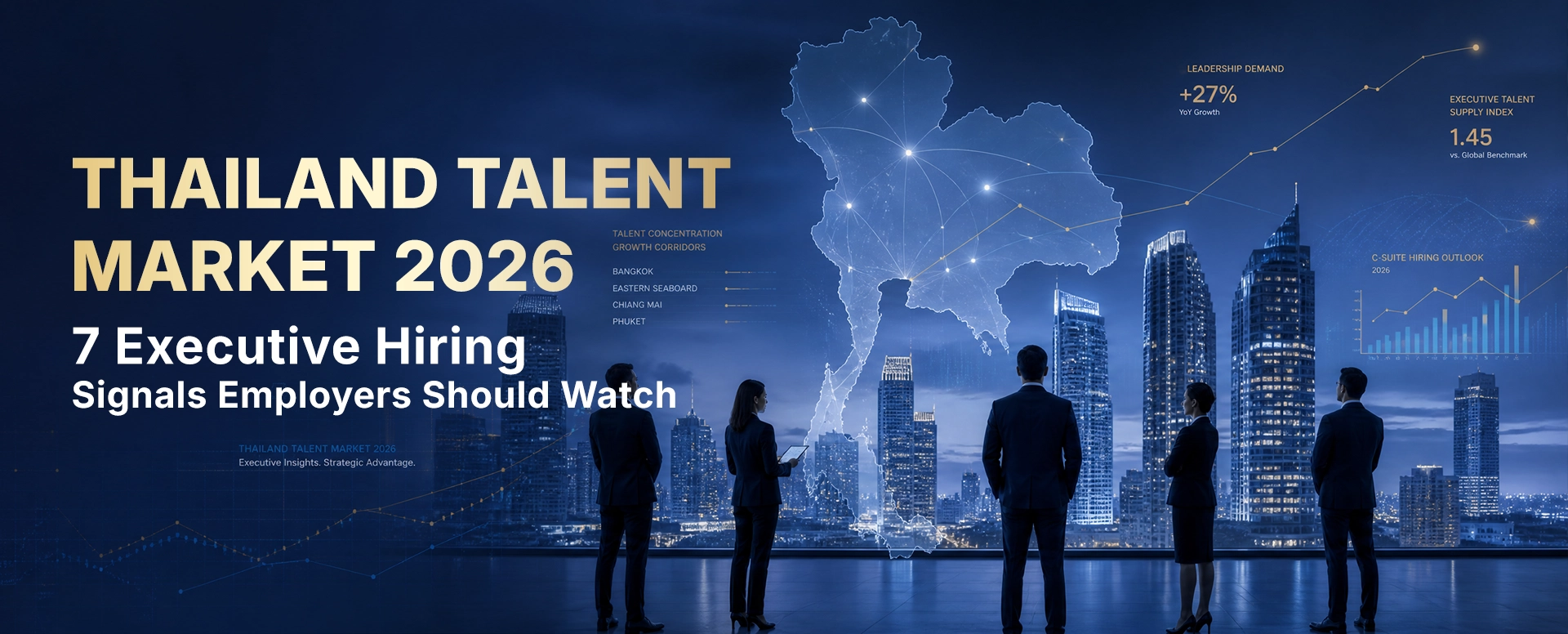
Thailand talent market 2026 is being shaped by a clear paradox: employers are becoming more selective about who they hire, while competition for proven senior leaders remains intense. For CEOs, CHROs and regional HR teams, this means the central hiring question is no longer simply, “How many candidates are available?” It is, “Where does the leadership capability we need actually sit, and what will it take to engage it?”
Public investment data provides important context. The Thailand Board of Investment (BOI) reported that investment promotion applications in the first half of 2026 reached approximately USD 38.7 billion across 1,300 projects, with approved projects expected to generate more than 82,000 jobs. The strongest momentum is concentrated in sectors such as digital infrastructure, AI, advanced electronics, EV-related manufacturing and other strategic industries.
These investment figures do not translate directly into executive vacancies. They do, however, indicate where business expansion, new operating models and organizational complexity are likely to increase demand for leaders across operations, finance, technology, engineering, supply chain, commercial functions and country management.
This outlook combines public market signals with 43 Synchronize’s executive-search perspective to identify seven critical developments employers should consider before entering the Thailand talent market in 2026. For related employer intelligence, explore our Thailand Market Insights.
Table of Contents
- Thailand Talent Market 2026 at a Glance
- 1. Selective Hiring Is Increasing the Value of Proven Leadership
- 2. Investment Is Reshaping Where Leadership Demand Appears
- 3. Passive Talent Makes Market Mapping More Important
- 4. Manufacturing Leadership Is Becoming More Complex
- 5. Digital and AI Investment Is Expanding the Leadership Mandate
- 6. Executive Compensation Is Becoming a Multi-Pillar Proposition
- 7. Hiring Speed and Candidate Experience Are Strategic Advantages
- Explore Thailand Hiring Markets by Industry
- What Employers Should Do Before Hiring in Thailand
Thailand Talent Market 2026 at a Glance
The Thailand talent market 2026 should not be viewed as one single national hiring market. Leadership demand is increasingly shaped by industry, investment cycle, ownership structure, business mandate and the maturity of each organization.
| Market Signal | What It Means for Employers |
|---|---|
| Selective hiring | Employers are placing greater weight on candidates who can demonstrate immediate business relevance. |
| Strategic investment | Digital, advanced manufacturing, electronics and EV-related activity are increasing leadership complexity. |
| Passive senior talent | The strongest candidate may not be actively applying or visible on a job board. |
| Transformation pressure | Leadership roles increasingly require change, technology and cross-functional execution capability. |
| Compensation complexity | Base salary alone may be insufficient to attract a successful executive away from an established role. |
| Regional-local alignment | MNCs need leaders who can translate regional strategy into Thailand execution. |
| Speed of decision | Slow processes can weaken an employer’s ability to convert scarce candidates. |
1. Selective Hiring Is Increasing the Value of Proven Leadership
In an uncertain business environment, many organizations are becoming more disciplined about headcount. That does not mean leadership hiring disappears. In many cases, it makes senior appointments more important because each executive hire carries greater responsibility for revenue, transformation, efficiency and organizational stability.
A candidate who has performed well in a familiar environment is not automatically the right leader for a new organization. Employers increasingly need to understand the context behind the results: business size, P&L ownership, decision authority, team scale, stakeholder environment, transformation stage and market complexity.
For the Thailand talent market 2026, this shifts the emphasis from resume volume toward evidence of relevant execution capability. A shorter, better-calibrated shortlist can be more valuable than a large group of superficially similar profiles.
2. Investment Is Reshaping Where Leadership Demand Appears
Thailand’s investment landscape is changing quickly. According to the Thailand Board of Investment, investment promotion applications in the first half of 2026 reached approximately USD 38.7 billion across 1,300 projects.
The BOI has also highlighted strong activity in digital infrastructure, AI, advanced electronics, EV supply chains and high-value manufacturing. Employers should treat these developments as talent-market signals. New capital investment usually creates requirements that extend beyond technical headcount into operational leadership, financial control, supply chain design, commercial development, regulatory coordination and organizational scaling.
The result is a market where leadership demand may emerge faster than the visible candidate market can respond. Companies entering or expanding in Thailand should therefore evaluate talent availability before finalizing organizational structures or compensation budgets.
For broader economic context, employers can also review the BOI’s Thailand macroeconomic indicators, which consolidate official data from agencies including NESDC, the Ministry of Labour and the Ministry of Commerce.
3. Passive Talent Makes Market Mapping More Important
One of the most important characteristics of the senior Thailand talent market 2026 is that availability and capability are not the same thing.
Executives with strong track records are often already employed. They may be leading revenue growth, restructuring operations, managing transformation or running critical functions for another organization. These individuals may be open to the right opportunity without actively submitting applications.
This is why employers should understand the candidate universe before depending on job advertisements. Talent mapping can identify where relevant leaders sit across direct competitors, adjacent industries, comparable business models and potential successor populations.
Market mapping also helps answer questions that a job board cannot:
- How many credible leaders appear to exist in the relevant market?
- Which companies are producing the type of experience required?
- Are there strong candidates in adjacent sectors?
- What level of compensation or role scope may be required to create movement?
- Should the employer adjust the mandate before beginning direct outreach?
For senior or confidential hiring, understanding the market before contacting candidates can significantly improve search precision. Employers preparing a business-critical search can also review our Executive Search Thailand service or speak confidentially with our team about the available leadership market.
4. Manufacturing Leadership Is Becoming More Complex
Thailand remains an important manufacturing base, but the leadership profile required by modern industrial organizations is changing. Automation, digital production systems, supply-chain resilience, sustainability requirements and regional reporting structures are expanding the mandate of plant and operations leaders.
A Plant Manager who has succeeded in a stable, mature facility may require a different leadership profile from a Plant Manager expected to automate production, reduce costs, build a new facility or manage a multi-site transformation.
Employers should therefore assess manufacturing leaders through operating context, not job title alone. Relevant dimensions include plant scale, workforce size, automation maturity, quality systems, transformation experience, regional reporting, capital expenditure and supply-chain complexity.
43 Synchronize supports employers across manufacturing and supply-chain recruitment in Thailand, including leadership roles across plant management, operations, engineering and supply chain. For specialist technical mandates, employers can also explore our Engineering Recruitment Thailand capability.
5. Digital and AI Investment Is Expanding the Leadership Mandate
Digital investment is creating demand that goes beyond conventional IT management. Organizations increasingly need leaders who can connect technology investment to revenue, productivity, customer experience, risk management and organizational change.
This affects roles such as CTO, CIO, Head of Digital, Transformation Director, Data leadership and technology-focused country or business leaders.
The key hiring question is not simply whether a candidate understands technology. It is whether that person can translate technology into business outcomes while managing stakeholders, budgets, teams and execution risk.
For organizations building or upgrading technology leadership, see our guide on hiring a CTO in Thailand and our IT & Technology Recruitment Bangkok expertise page.
6. Executive Compensation Is Becoming a Multi-Pillar Proposition
Compensation remains a critical part of the Thailand talent market 2026, but senior candidates rarely evaluate a move on base salary alone.
An executive proposition may include:
- Base salary
- Short-term performance incentives
- Long-term incentives
- Equity or deferred compensation
- Role authority and reporting line
- Regional exposure
- Benefits and allowances
- Relocation or transition support
The right structure depends on the mandate, industry, company size, candidate scarcity and transition risk. Employers should therefore benchmark the total opportunity rather than treating compensation as a single monthly number.
For a deeper discussion, read our C-Level Salary Thailand 2026 guide.
7. Hiring Speed and Candidate Experience Are Strategic Advantages
Executive search requires careful assessment, but careful does not have to mean slow.
When a strong passive candidate begins considering a move, the employer is not evaluating that candidate alone. The candidate is also evaluating the organization: the clarity of the mandate, quality of leadership communication, authority of the role, speed of decision-making and confidence in the company’s future.
A fragmented process can damage candidate confidence. Repeated interview stages, changing requirements, unclear reporting lines or delayed decisions may signal that the organization itself is not aligned.
In the Thailand talent market 2026, companies can improve their position by defining decision-makers, assessment criteria, compensation parameters and approval processes before candidate outreach begins.
Explore Thailand Hiring Markets by Industry
Executive and professional talent conditions differ significantly by sector. Employers can explore 43 Synchronize’s industry-specific recruitment capabilities below:
- Banking & FinTech Recruitment Thailand
- IT & Technology Recruitment Bangkok
- Construction & Real Estate Headhunter Thailand
- FMCG & Retail Recruitment Thailand
- Manufacturing & Supply Chain Headhunter Thailand
- Healthcare & Pharmaceutical Recruitment Bangkok
For a broader view of our functional and industry coverage, visit Specialized Recruitment Bangkok.
What the Thailand Talent Market 2026 Means for Employers
Before launching an executive search, employers should answer five questions.
1. What Business Outcome Must the New Leader Deliver?
Define the mandate in commercial and organizational terms. “Hire a CFO” is a job title. “Prepare the business for regional expansion while strengthening financial control and investor reporting” is a hiring mandate.
2. Where Does the Relevant Talent Actually Sit?
Map direct competitors, adjacent sectors, relevant operating models and potential successor candidates before narrowing the search.
3. Is the Compensation Structure Competitive for the Mandate?
Benchmark the total executive proposition against the complexity of the role and the transition risk expected from target candidates. For finance leadership mandates, see our Finance Sourcing Thailand capability.
4. What Would Make a Successful Executive Consider Moving?
Passive candidates need a reason to engage. Role authority, transformation scope, growth potential, board exposure or regional responsibility can be as important as compensation.
5. Is the Organization Ready to Make a Decision?
Align the board, CEO, HR and other stakeholders before outreach. Search quality cannot compensate for an unclear mandate or an approval process that changes midway through the assignment.
From Talent Availability to Market Intelligence
The central lesson from the Thailand talent market 2026 is that executive hiring should begin before a resume reaches the inbox.
Employers need to understand the business mandate, relevant talent universe, competitor landscape, compensation environment and candidate motivations before deciding how to search.
43 Synchronize combines executive search in Thailand, direct cold hunting, passive candidate engagement and market intelligence to help employers reach senior leaders beyond the visible applicant market. You can also review our full Executive Search & Recruitment Services for additional hiring solutions.
For organizations that need to evaluate talent availability before launching a search, our Talent Mapping and Market Intelligence service can help define the candidate universe and support more informed hiring decisions.
Planning a senior leadership hire in Thailand?
Request a confidential hiring consultation with 43 Synchronize.
Frequently Asked Questions
What is the Thailand talent market 2026 outlook for executive hiring?
Executive hiring remains selective, but strong demand continues for leaders who can manage transformation, technology, industrial complexity, commercial growth and regional-local execution. Talent availability varies significantly by role and industry, so market mapping is important before setting a search strategy.
Which industries are influencing leadership demand in Thailand in 2026?
Public investment activity points to continued momentum in digital infrastructure, AI, advanced electronics, EV-related manufacturing and other strategic industries. These sectors can create demand for leadership across technology, engineering, operations, finance, supply chain and commercial functions.
Why is talent mapping useful before executive recruitment?
Talent mapping helps employers understand where suitable leaders work, how large the candidate universe may be, which adjacent industries can provide transferable experience and whether the role or compensation package needs adjustment before direct outreach.
Are senior executives in Thailand actively looking for jobs?
Some are, but many strong senior leaders are already employed and may only consider a move when approached with a relevant and credible opportunity. This is why executive search often requires direct and confidential engagement rather than relying only on applications.
How should employers structure executive compensation in 2026?
Employers should assess the total executive value proposition, including base salary, incentives, long-term rewards, benefits, authority, role scope and transition support. The appropriate structure varies by industry, mandate and candidate scarcity.
